The human eye is one of the sense organ’s which allows us to see. It gives us the sense of sight, allowing us to observe and learn more about the surrounding world than we do with any of the other four senses, that allows us to see and sense danger therefore staying safe in our environment. We use our eyes in almost every activity we perform, whether reading, working, watching television, writing a letter, driving a car, and in countless other ways. Most people probably would agree that sight is the sense they value more than all the rest.
The eye allows us to see and interpret the shapes, colours, and dimensions of objects in the world by processing the light they reflect or emit. The eye is able to detect bright light or dim light, but it cannot sense objects when light are absent.
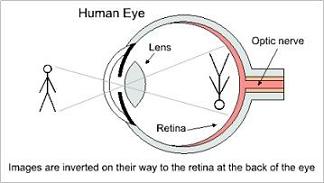
Light waves from an object, as shown in the diagram,enter the eye first through the cornea, the clear dome at the front of the eye. The light then progresses through the pupil, the circular opening in the center of the colourediris.
Fluctuations in incoming light change the size of the eye’s pupil. When the light entering the eye is bright enough, the pupil will constrict (get smaller), due to the pupillary light response.
An inverted image is focused by the cornea and lens on to the retina, with an aperture controlled by the pupil.
The retina contains two classes of photoreceptors (duplex retina): ca. 5 million cones for daylight (photopic vision) and ca. 100 million rods for dusk (mesopic) and night vision (scotopic). A region of maximum resolution (fovea) with the highest density of cones subserves our most acute vision. Eye movements fixate objects of interest on this region. Photoreceptor signals are processed by retinal interneurons, generating an output which is transmitted by the axons of 1.5 million ganglion cells in the optic nerve. For conscious perception, information from the optic nerve passes to the visual cortex, via a thalamic relay station - the lateral geniculate nucleus (LGN). Other pathways projects to the superior colliculus (important for eye movements), the pretectal region (e.g. for controlling the pupil) and hypothalamus (entraining circadian rhythms).
Cash help for eye treatment venture
NEW technology being developed to deliver sight-saving treatment to the inside of the eye has won almost £160,000 in grants to develop the idea commercially in Northumberland.
Ophthalmologist and medical researcher Dr Alan Whitmore set up Lumemed Ltd to take...
More Effective Treatment Identified for Common Childhood Vision Disorder
Scientists have found a more effective treatment for a common childhood eye muscle coordination problem called convergence insufficiency (CI). For words on a page to appear in focus a child’s eyes must turn inward, or...
Promising Results in Phase 1 Gene Therapy Trial for Blinding Disease
Three young adults with an inherited form of blindness showed evidence of improved day and night vision following a specialized gene transfer procedure in a phase 1 clinical trial funded by the National Eye Institute (NEI), part...
Visions of the Future: Telescopic Eyeglasses Improve Myopic Sight
Nearsightedness, also known as myopia, is one of the most common visual defects, afflicting more than 2 billion people worldwide. This condition results when the eyeball is too long or the cornea angle is too steep to focus light on...
Older Treatment May Be More Effective in Preserving Sight for Some Patients with Diabetes
New Drug Treatment Not as Successful and had More Side Effects than Laser Treatment
A promising new drug therapy used to treat abnormal swelling in the eye-a condition called diabetic macular...
World’s first gene therapy for inherited blindness
Improvements to sight shown in results of world’s first gene therapy for inherited blindness
UK researchers from the UCL Institute of Ophthalmology and Moorfields Eye Hospital NIHR Biomedical Research Centre have announced results from the world’s...